Advanced Kayak Coaching Victoria: Master Technical Paddling
Advanced technical paddling mastery combines combat rolling, precision boat control, and expert river reading across hard kayaks and packrafts. Canoes Plus Kayak School & Adventure Experiences, operating in Melbourne and Victoria since 1972, builds these skills through structured whitewater instruction, essential paddle-stroke refinement, and progressive on-river coaching designed for intermediate and advanced paddlers pushing into demanding rapids and technical terrain.
Our Advanced Paddling Mastery lessons are conducted on Grade 3, and require prior paddling ability. The lessons are by appointment and require good water levels on the rivers we use.
What Will You Achieve With Advanced Paddling Mastery?
Advanced paddling mastery delivers command over technical paddling whitewater, sharper river judgment, and the physical control needed to handle grade III-IV rapids with confidence. Canoes Plus has provided kayak courses, packraft training, and whitewater instruction across Victoria since 1972, giving intermediate and advanced paddlers a proven pathway to refine skills that recreational courses rarely touch.
Progression at this level moves past basic forward strokes and into precision maneuvers. Paddlers work toward the following outcomes through structured coaching:
Reliable execution of the combat roll kayak or sefl rescue packraft technique under pressure, without hesitation or panic
Confident decision-making during advanced river running Victoria trips, including line selection through complex rapids
Comfort transitioning between a hard shell vs packraft whitewater setup, adapting stroke technique to each craft's handling
Access to advanced kayak coaching Victoria paddlers trust for structured, skill-specific progression rather than generic lessons
How Long Does It Take to Build a Reliable Combat Roll?
Building a dependable roll depends on water time, coaching quality, and prior bracing skills, so timelines vary from paddler to paddler. Guided repetition under a qualified eye shortens the learning curve considerably compared to self-taught practice. Consistency across multiple sessions, not a single lesson, produces a roll that holds up in genuine whitewater conditions.
Coaching from a master kayak instructor Australia paddlers recognize as experienced carries real weight here. Canoes Plus ranks among Australia's most experienced kayak, canoe, and packraft training providers. Has helped thousands of paddlers develop skills, confidence, and safety awareness on rivers, lakes, and whitewater for more than five decades. That depth of instruction translates directly into faster, safer progress toward advanced technical paddling.
What Skills And Gear Should You Prepare First?
Two priorities matter before tackling advanced whitewater: solid boat control and gear matched to the river's demands. Paddlers moving into advanced technical paddling need a self-rescue skill set, a reliable roll, and a craft suited to the rapid class ahead. Preparation, not enthusiasm alone, separates a confident run from a dangerous one.
What skills come first?
Boat control tops the list, followed by a dependable combat roll. A paddler capable of executing a combat roll kayak packraft technique in moving water avoids the swim that stalls momentum. Shakes confidence on a committing rapid. Reading current lines, eddies, and hazards ranks just as high. This is the foundation of advanced river running Victoria paddlers rely on when conditions shift fast.
Preparation follows a logical order:
Master flatwater bracing and edge control before adding current.
Practice rolling in controlled conditions until it becomes automatic.
Build eddy-turn and ferry-angle precision on moderate rapids.
Progress to technical paddling whitewater sections only once the above feels instinctive.
Hard-shell or packraft — which suits advanced water?
Choice depends on the trip's demands, not personal preference alone. Hard-shell kayaks are rigid boats, typically built from plastic, fiberglass, or composite materials. They hold a tighter line through pushy rapids. Packrafts, by contrast, are inflatable boats made from lightweight, durable materials, prized for portability into remote put-ins. The hard shell vs packraft whitewater decision often comes down to access: if a river demands a long carry-in, the packraft wins. If precision and speed dominate, the hard shell does.
Every instructor guiding these sessions holds Paddle Australia qualifications, Swiftwater certification, and Wilderness First Aid training. Credentials that underpin the advanced kayak coaching Victoria paddlers trust before stepping into Class III-plus water. That standard reflects the caliber expected of a master kayak instructor Australia paddlers seek out when the stakes rise.
How Do You Choose Between Hard Shell And Packraft?
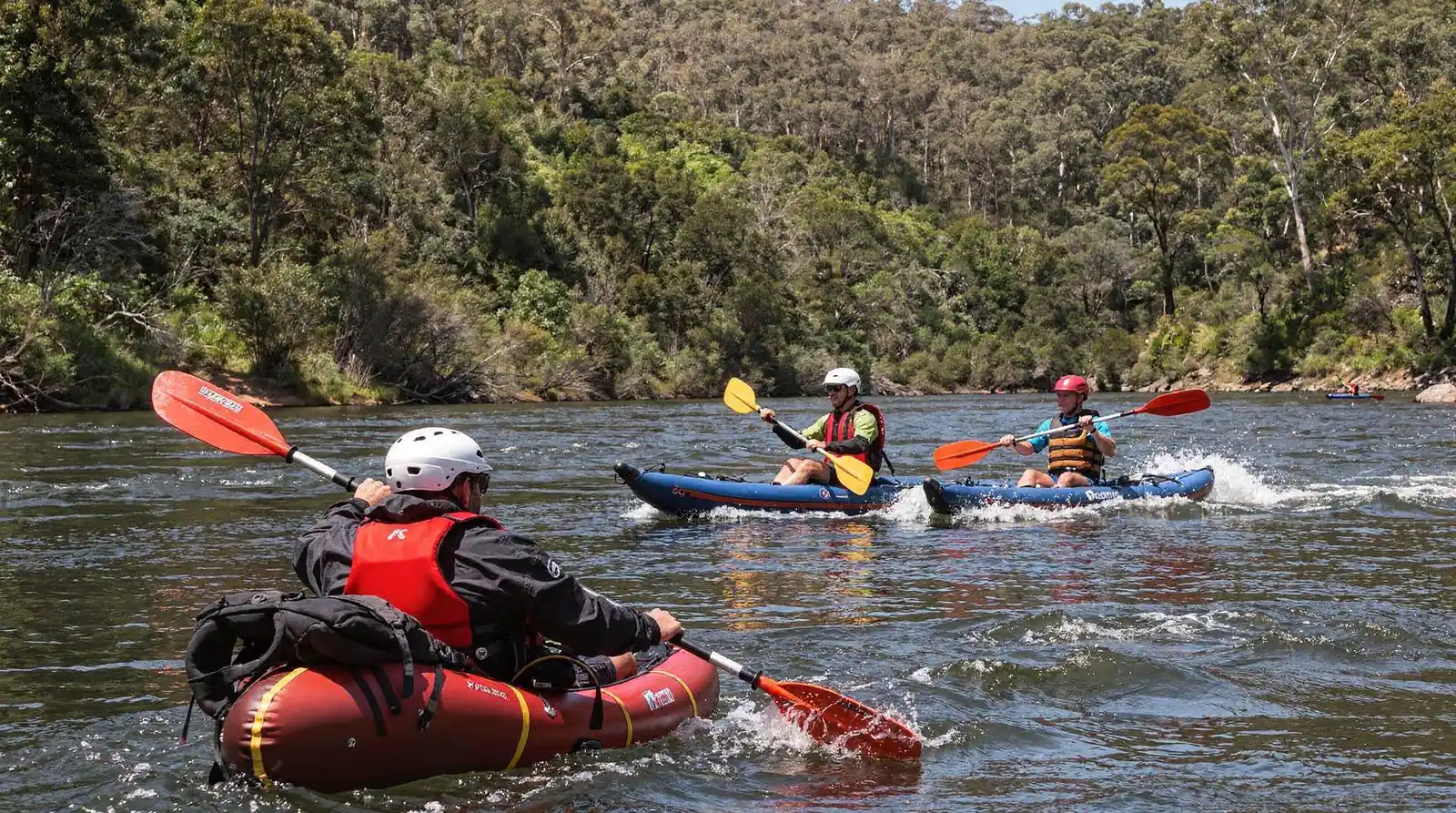
Craft selection depends on trip goals, terrain, and how much a paddler values speed versus portability. Hard-shell kayaks and packrafts each solve different problems on the water, and neither one wins in every scenario. Canoes Plus Adventure Experience offers a full range of paddling courses and adventures, spanning both hard-shell instruction and packraft training. Paddlers can test each craft before committing to one.
Hard shell vs packraft whitewater performance comes down to a straightforward tradeoff. Rigid kayaks are engineered for efficiency, delivering better speed, tighter tracking, and greater comfort across long, demanding sessions. Packrafts sacrifice some of that speed for portability, folding down small enough to carry on multi-sport trips that mix hiking with paddling. That difference shapes which craft suits which paddler.
Which Craft Suits Advanced Whitewater Paddlers?
Paddlers chasing advanced technical paddling on steep, continuous rapids typically favor hard-shell kayaks for their tracking precision and edge control. Packrafts remain a strong option for remote river descents where the boat must be carried between put-ins. Many experienced paddlers keep both in rotation, matching the craft to the specific river and access requirements.
The table below breaks down the core differences:
Factor | Hard-Shell Kayak | Packraft |
|---|
Speed & tracking | Superior on long, technical stretches | Slower, less directional |
Portability | Requires vehicle transport | Packs down for hiking access |
Comfort on long runs | Higher, built for efficiency | Lower over extended distances |
Best use case | Sustained whitewater sessions | Multi-sport, remote expeditions |
Do Beginners Need To Choose One Craft Permanently?
No paddler needs to commit to a single craft type early on. As one of Australia's most experienced paddling schools, Canoes Plus Kayak School guides students through both disciplines, building a foundation that supports informed decisions later. Trying each craft under qualified instruction remains the most reliable way to determine long-term fit.
How Do You Master The Combat Roll In Each Craft?
Mastering the combat roll kayak packraft technique starts with understanding how cockpit design changes the mechanics underwater. A hard-shell kayak's closed cockpit and spray skirt create a sealed connection between paddler and hull. A packraft's open cockpit demands a different set of movements entirely. Recognizing this distinction before hitting the water separates paddlers who roll reliably from those who swim after every capsize.
What Makes Rolling A Hard-Shell Kayak Different From A Packraft?
A hard-shell kayak locks the paddler inside a closed cockpit, with a spray skirt sealing out water and keeping the hull attached to the body during the roll. This sealed setup means the boat and paddler move as one unit, which makes the hip-snap more efficient once technique is dialed in. A packraft's open cockpit design, by contrast, removes that tight connection. The paddler relies more on body positioning and paddle leverage to bring the craft upright. Understanding hard shell vs packraft whitewater rolling differences prevents frustration when a technique that works in one boat fails in the other.
Progressing through the combat roll kayak packraft skill set follows a logical sequence regardless of craft:
Practice the wet exit and re-entry in calm, apartment water before attempting any roll.
Drill the hip-snap motion using a pool noodle or paddle float for support.
Add the paddle stroke once the hip-snap becomes automatic.
Move to moving water only after ten consistent rolls on apartment water.
Introduce technical paddling whitewater conditions gradually, starting with Class II rapids.
Do Packrafts Roll The Same Way As Kayaks?
No, packrafts require adjusted technique because the open cockpit offers less contact between paddler and hull. Paddlers transitioning between crafts benefit most from coaching that addresses both systems side by side. Canoes Plus instructors deliver hands-on coaching built around each paddler's experience level. Specific combat roll goals, covering both hard-shell and packraft technique within the same progression. This tailored approach supports advanced technical paddling development across whichever craft a paddler chooses to run.
How Do You Read Advanced Whitewater Like A Pro?
Reading advanced whitewater requires trained eyes, patient practice, and instruction built on decades of river experience. Canoes Plus instructors have developed advanced river running Victoria expertise by studying rivers, lakes, and rapids across the state for more than 50 years. That depth of exposure shapes how coaching sessions break down current, hydraulics, and line selection for paddlers ready to move beyond intermediate skills.
Mastering technical paddling whitewater demands a repeatable process rather than guesswork. Advanced students at Canoes Plus Kayak School work through a structured sequence on every new rapid:
Scout the rapid from shore before committing to a line.
Identify hazards first, then locate the safest entry point.
Trace the intended route against eddies, waves, and hydraulics.
Commit to the line with decisive, confident strokes.
Debrief with an instructor to refine reading skills for next time.
This method reflects advanced kayak coaching Victoria paddlers rely on to build judgment, not just technique.
What Skills Separate Intermediate From Advanced Paddlers?
Confidence under pressure separates the two groups more than raw stroke count. Advanced paddlers execute a combat roll kayak packraft setup without hesitation when flipped in turbulent water, treating the roll as instinct rather than a rehearsed drill.
Should Paddlers Choose A Hard Shell Or A Packraft For Whitewater?
The hard shell vs packraft whitewater decision depends on the mission, not just preference. Packrafting opens access to remote wilderness waterways that rigid kayaks often cannot reach, making it a natural complement to hard-shell river running rather than a replacement.
Coaching from a master kayak instructor Australia paddlers trust brings these elements together. Canoes Plus Adventure Experience draws on its standing as one of Australia's most experienced paddling schools to guide advanced students toward sharper river reading and genuinely advanced technical paddling confidence.
How Do You Refine Technical Strokes At Higher Grades?
Refining technical strokes at higher river grades demands structured coaching, repeated drilling, and exposure to progressively harder water. Canoes Plus builds this progression into its advanced kayak coaching Victoria programs, offering a full range of paddling courses that includes advanced whitewater kayaking instruction designed specifically to sharpen stroke work as paddlers move up in difficulty.
Strong technical paddling whitewater skills come from breaking movement into repeatable steps rather than relying on instinct alone. Paddlers looking to sharpen boof strokes, high braces, and eddy transitions benefit from a clear sequence:
Isolate the stroke on apartment water before introducing current.
Add moving water at a lower grade to test timing under pressure.
Progress to higher-grade rapids only once the stroke holds up consistently.
Review each run with a qualified coach to correct drift in technique.
This staged approach also supports combat roll kayak packraft practice. A reliable roll under real current conditions separates confident paddlers from those who hesitate at the wrong moment.
Should Paddlers Train In A Hard Shell Or A Packraft?
Choice of craft shapes how strokes translate to bigger water. Weighing hard shell vs packraft whitewater performance, some paddlers select inflatable or hybrid kayaks as a flexible middle ground, using them to practice technical strokes between hard shell sessions and dedicated packraft outings.
Why Does River Access Matter For Skill Progression?
Skill progression stalls without access to demanding water. Packrafts let paddlers carry a boat directly into remote river sections, opening up stroke practice on waterways that hard shell kayaks simply cannot reach on foot.
Guidance from a master kayak instructor Australia paddlers trust turns these elements into a coherent plan. Structured feedback, staged exposure to harder rapids, and deliberate craft selection together define genuine advanced technical paddling development, supporting advanced river running Victoria ambitions at every grade.
How Can Expert Coaching Speed Up Your Progress?
Structured coaching closes the gap between casual paddling and true command of whitewater. Progress accelerates when technique breakdown, safety systems, and river-reading skills come from a qualified guide rather than trial and error. Canoes Plus Adventure Experience built its coaching model around this principle, pairing paddlers with instructors who tailor sessions to individual skill gaps and goals.
Advanced kayak coaching Victoria programs at Canoes Plus draw on qualified instruction from Paddle Australia, the sport's governing body for coaching and safety standards. Sessions move beyond basic strokes into advanced technical paddling: precision boat control, eddy turns, and reading complex hydraulics before committing to a line. Because instruction is hands-on and paddler-specific, coaching adapts whether the goal is refining a combat roll kayak packraft technique or preparing for advanced river running Victoria trips on grade III-IV water.
What qualifications should an advanced coach hold?
Every instructor at Canoes Plus carries Paddle Australia certification, Swiftwater rescue qualifications, and Wilderness First Aid training. That combination matters most on technical paddling whitewater. Rescue readiness and medical response can matter as much as stroke technique.
Does coaching differ for hard shell versus packraft paddlers?
Coaching content shifts to match the craft. Hard shell vs packraft whitewater technique differs in edge control, bracing, and roll mechanics. Instructors adjust drills accordingly rather than applying a single template.
Decades of operating since 1972 give Canoes Plus instructors depth few schools in the region can match. That history, paired with credentials, positions its team among the most established groups offering master kayak instructor Australia guidance for paddlers pushing into serious whitewater. Instructors typically build sessions around:
Assessment of current stroke mechanics and roll reliability
Targeted drills for edge control and boat lean
River-reading practice on progressively harder rapids
Rescue and self-rescue skill checks
What Common Mistakes Should You Watch For?
Skipping gear checks ranks among the most frequent errors intermediate paddlers make before tackling harder rapids. Overconfidence in a borrowed or aging craft causes more swims than poor technique does. Advanced river running Victoria trips demand equipment that matches the rapid's difficulty, not just enthusiasm to run it.
Paddlers moving into technical paddling whitewater often underestimate how much a hull's construction matters. A packraft's durable, stretch-free TPU fabric and hand-made build separate a dependable boat from a flimsy inflatable that flexes and loses pressure mid-rapid. Choosing the wrong craft, or one built from cheaper materials, turns a manageable line into a dangerous one.
Should Paddlers Practice a Combat Roll Before Running Harder Rapids?
Yes — a reliable combat roll kayak packraft skill set separates paddlers who recover quickly from those forced to swim in cold, technical water. Many intermediate paddlers practice rolling only in apartment water and never test it under current pressure. That gap shows up fast on a real rapid, where hesitation costs seconds that matter.
Is Hard Shell Or Packraft Better For Whitewater Mistakes-Wise?
The hard shell vs packraft whitewater debate isn't about which boat is superior. It's about matching craft to conditions and skill level. Common mistakes include:
Running technical drops in an under-inflated or worn packraft
Skipping a pre-launch gear inspection
Ignoring instructor feedback on line choice
Canoes Plus Adventure Experience, based in Epping, Victoria, gives paddlers a home base for gear checks and coaching follow-up between sessions. Instructors hold Paddle Australia, Swiftwater, and Wilderness First Aid qualifications, supporting safe troubleshooting whenever technique breaks down on the water.
FAQ
What is the difference between hard kayaks and packrafts for technical paddling?
Hard kayaks offer superior rigidity and durability for technical conditions. Packrafts weigh significantly less, making them ideal for backcountry expeditions where portability determines trip success.
How long does it take to develop a reliable combat roll?
Timelines vary based on water time, coaching quality, and prior bracing skills. Guided repetition under a qualified instructor, like those at Canoes Plus, shortens the learning curve compared to self-taught practice.
What should paddlers prepare before attempting advanced whitewater?
Paddlers need solid boat control, a dependable combat roll, self-rescue skills, and a craft matched to the rapid class ahead. Preparation, not just enthusiasm, ensures a confident and safe run.
Conclusion
In closing, mastering advanced technical paddling demands dedication, proper instruction, and quality equipment suited to challenging conditions. Whether you pursue hard kayaks or packrafts, the skills you develop transform your relationship with water and wilderness. Canoes Plus Adventure Experience stands ready to guide you through this progression, equipping you with the expertise and confidence to tackle demanding paddling environments with competence and respect for the natural world.
